Roof Flashing in North Idaho: What It Is, Why It Fails, and How to Spot It
If you've watched water come in around a chimney during a storm, or found a ceiling stain that seemed to come from nowhere, flashing is one of the first things to check. It's the most overlooked part of a roof. Here's what it does, where it goes, and how to tell when it has stopped working.
- Flashing is the thin metal, or sometimes rubber or membrane, that seals the joints and openings shingles can't seal on their own.
- It goes in seven common places: chimneys, vent pipes, skylights, valleys, along walls (step flashing), kickouts at the bottom of roof-to-wall joints, and the drip edge.
- From the ground, look for tar around the chimney, rust streaks, flashing pulled away from a wall, and rotted siding below a roof-to-wall joint.
- Anything that means getting on the roof is a job for a roofer. On a Lakeview replacement, every joint and opening gets new flashing.
On this page
What Is Roof Flashing?
Flashing is thin metal, or sometimes rubber or membrane, installed wherever the roof meets something else: a chimney, a wall, a vent, a skylight, a valley, or the roof edge. Its job is to shed water where shingles alone can't keep it out.
Most flashing on North Idaho homes is galvanized steel or aluminum. Some older homes have tar or roof cement smeared where flashing should be. That's a patch, not flashing, and patches don't hold up for long.
Where Does Flashing Go on a Roof?
Seven common places: around chimneys, vent pipes, and skylights, in the valleys, along walls as step flashing, at kickouts where a roof-to-wall joint ends at the eave, and along the eaves and gable edges as drip edge.
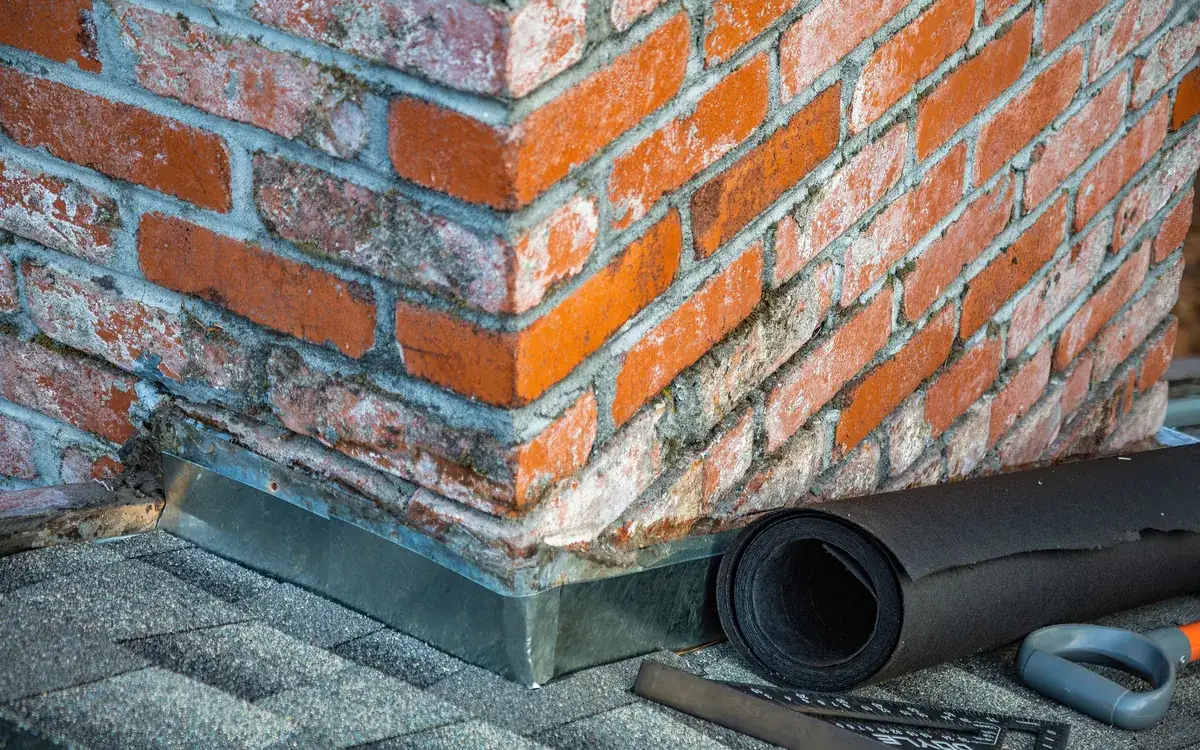
- Chimney: base flashing at the bottom, step flashing up the sides, and counterflashing set into the mortar over the top.
- Vent pipe boot: a collar that seals around each plumbing vent.
- Skylight: a flashing kit that ties the skylight frame into the shingles.
- Valleys: where two roof slopes meet, a valley liner under the shingles carries the extra water.
- Step flashing: L-shaped metal pieces woven into each shingle course where a roof runs along a wall.
- Kickout: a small angled piece at the bottom of a roof-to-wall joint that turns water away from the wall and into the gutter.
- Drip edge: the metal strip along the eaves and gable edges that guides water off the roof edge.
Owens Corning's installation instructions call for step flashing made of corrosion-resistant metal, at least 4 by 4 by 8 inches, wherever the roof meets a sidewall or chimney, and a 36-inch-wide valley liner under a closed-cut valley. Hayden's roof handout quotes the residential code's drip edge rule: drip edge is required at the eaves and gables of shingle roofs, with pieces overlapped at least 2 inches.
Chimneys deserve the closest look. Proper chimney flashing has three parts: base flashing at the bottom, step flashing up the sides, and counterflashing set into the mortar joints over the top edge. Tar smeared around a chimney usually means the original flashing failed and someone patched it.
Why Does Flashing Fail in North Idaho?
Water works into seams and freezes, ice dams back water up under the lowest courses at the eaves, rubber boots and sealants dry out with age and sun, and tar patches stand in for real flashing.
Freeze and thaw
Water that gets behind a flashing seam freezes and expands, opening the gap a little more each time.
Ice dam backup
When an ice dam forms at the eave, water pools behind it and works up under the lowest shingles and any flashing there. See our ice dam guide.
Age and sun
Rubber vent boots and sealants dry out and crack over time, and a cracked boot lets water run down the pipe into the attic.
Patches instead of flashing
Tar and roof cement are a stopgap. Step flashing has to be replaced piece by piece, which is why shortcuts are common and short-lived.
How Can You Spot Bad Flashing From the Ground?
Use binoculars from the yard. Look for tar or roof cement around the chimney, rust streaks, flashing pulled away from a chimney or wall, stained or missing shingles below a vent or skylight, and rotted siding below a roof-to-wall joint.
- Tar or roof cement around the chimney: a sign the original flashing failed and was patched
- Rust streaks on chimney or wall flashing: the protective coating has worn through
- Flashing pulled away from a chimney or wall: even a small gap lets wind-driven rain in
- Stained or missing shingles below a vent pipe, skylight, or chimney
- Rotted siding or trim below a roof-to-wall joint: often a missing or failed kickout
- Water stains on ceilings or walls inside, especially near a chimney, skylight, or bathroom
Stay off the roofChecking flashing up close means walking the roof and working around chimneys and vents. Do your checks from the ground and leave the roof to a roofer.
Can You Repair Roof Flashing Yourself?
Checking from the ground and photographing what you find is a homeowner job. Anything on the roof, from a vent boot to step flashing to a chimney, is a job for a roofer.
| Level | Examples |
|---|---|
| Homeowner | Checking from the ground, looking for interior stains, taking photos |
| Roofer | Replacing a vent boot, resetting a piece of step flashing, tracking down an active leak |
| Larger repair | Reflashing a chimney, relining a valley, adding a kickout where there isn't one |
We price flashing work after we've seen the roof. A single vent boot is usually a small service call; chimney reflashing is a moderate repair, often quoted with other roof repairs. Start with a free roof inspection, or see our roof repair service.
Is New Flashing Included in a Roof Replacement?
At Lakeview, yes. Every chimney, vent, valley, wall joint, and eave gets new flashing as part of a full roof replacement. If a reroof quote doesn't include new flashing, ask why.
Repairing flashing makes sense when the rest of the roof has years left. If the roof is near the end of its life, a full roof replacement with new flashing throughout is usually the better call. Our repair vs. replacement guide walks through how to decide.
How Does Flashing Connect to Gutters, Ice Dams, and Ventilation?
Drip edge and kickouts send water into the gutters, ice dams push water up under the lowest flashing, and a well-ventilated attic keeps the roof deck cold so less snow melts and refreezes at the edge.
See gutter cleaning in North Idaho, our seamless gutter installation service, and why attic ventilation matters here.
Not Sure About Your Flashing?
A free inspection by our HAAG certified inspectors checks every chimney, vent, valley, and wall joint, with photos. We'll tell you straight what your flashing needs and what it doesn't.
Frequently Asked Questions
What is roof flashing and what does it do?
Roof flashing is thin metal, or sometimes rubber or membrane, installed at the joints and openings on a roof: around chimneys, vent pipes, and skylights, in valleys, along walls, and at the roof edge. It sheds water where shingles alone can't keep it out.
How do I know if my roof flashing is bad?
From the ground, look for tar or roof cement around the chimney, rust streaks, flashing pulled away from a chimney or wall, stained or missing shingles below a roof opening, rotted siding below a roof-to-wall joint, and water stains on interior ceilings. Any of these is worth an inspection before the snow.
Can I replace flashing myself?
Do the visual check from the ground, but leave the flashing work to a roofer. It means working on the roof, removing and weaving in shingles around the opening, and sealing joints properly. A flashing repair done wrong can make a leak worse.
Why does flashing fail in North Idaho?
Water works into seams and freezes, ice dams back water up under the lowest shingles at the eaves, rubber boots and sealants dry out with age and sun, and tar patches stand in for real flashing.
Is flashing included in a new roof?
It should be. On a Lakeview roof replacement, every chimney, vent, valley, wall joint, and eave gets new flashing as standard practice. If a reroof quote doesn't include new flashing, ask why.
Does insurance cover flashing repair?
It depends on the cause and your policy. Flashing damaged in a storm may be part of a storm damage claim; check your policy and ask your insurer. Our insurance claim guide covers how claims work in Idaho.
About this guide. Written by Lakeview Roofing & Restoration, a family-owned roofing company in Rathdrum, Idaho, and an Owens Corning Preferred Contractor with HAAG certified inspectors. Facts in this guide were checked against the sources listed below.